Physical Address
124 City Road, London EC1V 2NX
Physical Address
124 City Road, London EC1V 2NX
If you want to learn how to build an email list as a beginner, the first thing to know is this:
You do not need a complicated funnel, a huge audience, or a perfect system to start.
You need a simple email foundation.
That means having a clear way for someone to find your content, request something useful, join your list, receive the resource, and hear from you again in a helpful way.
At MMO Essentials, I like to keep things practical, calm, and beginner-friendly.
✅ No tech overwhelm
✅ No complicated funnel talk before you understand the basics
✅ No pretending you need 10,000 subscribers to begin
✅ Just one simple foundation you can build and improve
Understanding how to build an email list can change your marketing game.
To build an email list, you need five simple pieces:
✅ A clear audience
✅ A useful free resource
✅ A sign-up page or form
✅ A delivery email
✅ A few welcome emails
That is the basic version.
Not perfect.
Not advanced.
But real.
A simple email list system could look like this:
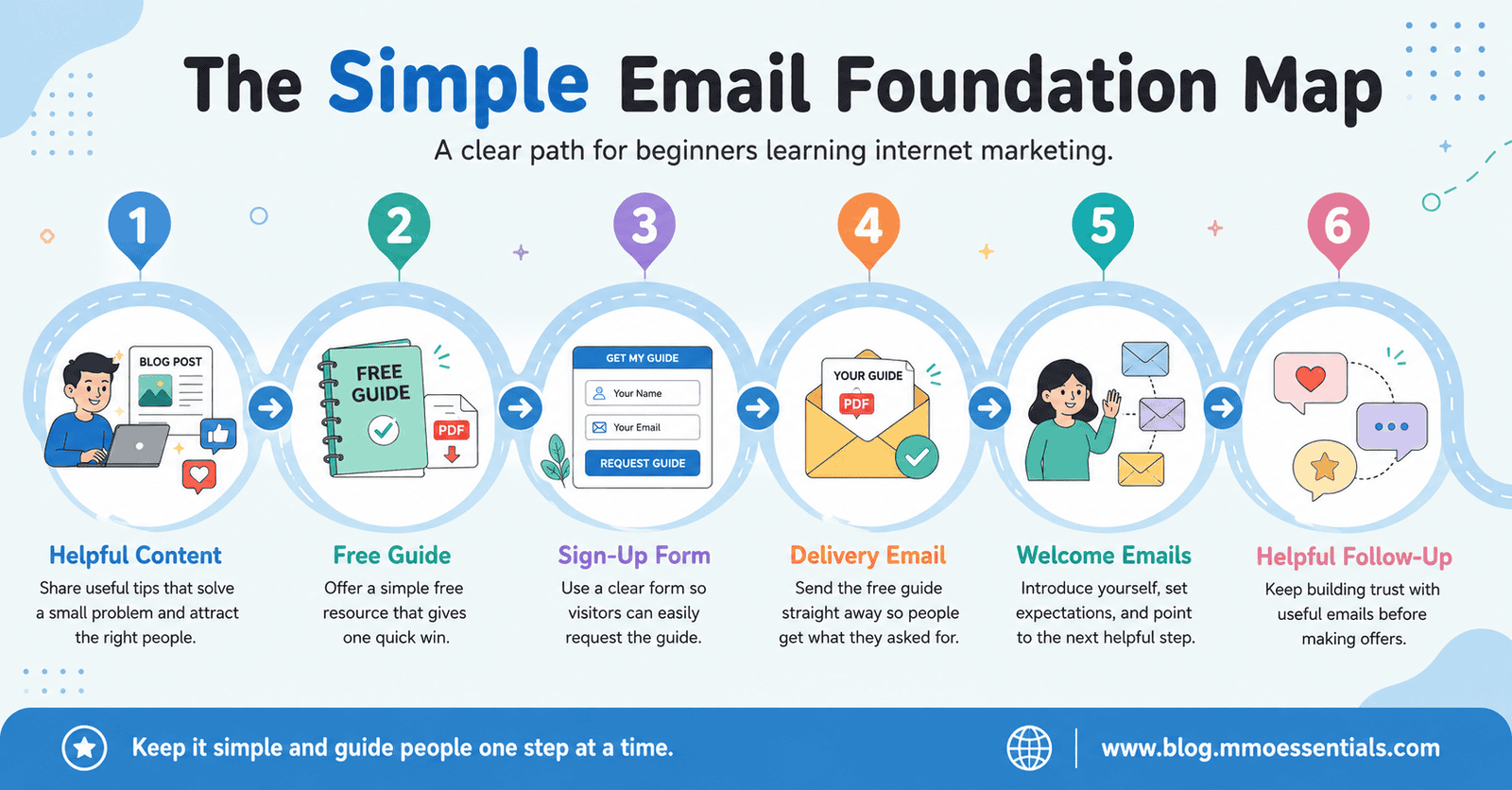
That is your starting foundation.
The goal is not to build the most advanced system on day one.
The goal is to build the first version you actually understand.
When you are new to online business, it is easy to focus only on traffic.
More views.
More clicks.
More followers.
More visitors.
Traffic matters, but traffic can disappear quickly.
Someone might read your blog post, watch your video, or see your social post, then leave and never come back.
Your email list gives them a way to stay connected.
Trust is built over time, especially when learning how to build an email list.
That matters because an online business is not just about getting attention. It is about building trust over time.
An email list helps you:
✅ deliver free resources
✅ follow up with helpful content
✅ build a relationship with readers
✅ share new blog posts or tutorials
✅ recommend useful tools when they genuinely fit
✅ learn what your audience actually cares about
This is especially important if you plan to use affiliate marketing later.
People are much more likely to trust a recommendation when they have already received helpful content from you.
Email marketing can sound complicated because people often introduce it with too many moving parts.
They talk about:
❌ advanced automations
❌ funnels
❌ segmentation
❌ tagging
❌ conversion rates
❌ broadcasts
❌ nurture sequences
❌ split testing
Those things can be useful later.
But they are not where most beginners need to start.
If you are just beginning, the better question is:
Can I create one simple path that helps someone join my list and receive something useful?
Can I create one simple path that helps someone join my list and receive something useful?
That is enough for the first version.
You can improve the system later.
Learning how to build an email list can help you engage your audience effectively.
Before you start learning how to build an email list, define your target audience.
Before creating a free resource or sign-up page, get clear on your audience.
Who are you helping?
This matters because a generic email list is hard to grow and even harder to write to.
A simple sentence can help:
I help __________ learn how to __________ without __________.
For example:
I help non-techie beginners learn how to build simple online systems without getting overwhelmed by tools.
That sentence gives your content direction.
Creating useful content is essential when learning how to build an email list.
It also helps you decide what kind of free resource your audience would actually want.
✨ Pro Tip: Do not try to attract everyone. The clearer your audience, the easier your emails become.
One key strategy in how to build an email list is to offer a lead magnet that resonates with your audience.
To build an email list, you need a reason for someone to join.
That reason is usually a free resource.
This is often called a lead magnet, but the simple explanation is:
A lead magnet gives someone a clear reason to join your email list.
It does not need to be huge.
In fact, huge can become the problem.
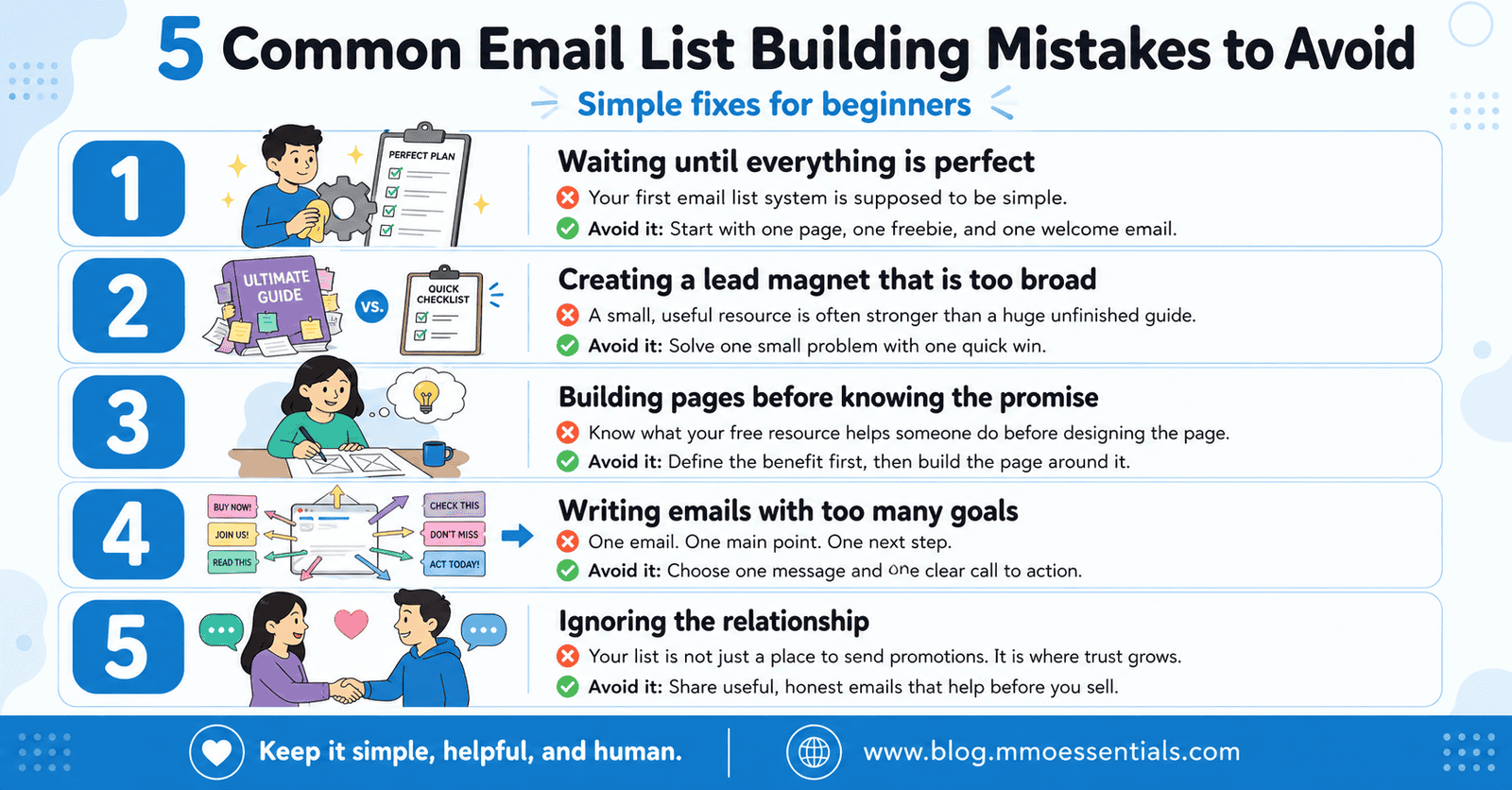
A good beginner lead magnet solves one small problem clearly.
Examples include:
✅ a checklist
✅ a short guide
✅ a worksheet
✅ a planner
✅ a template
✅ a quick-start map
✅ a beginner glossary
For example, instead of creating “The Complete Guide to Online Business,” you could create:
The First Email Foundation Checklist
Mastering the basics of how to build an email list is essential for growth.
That is smaller, clearer, and much easier to finish.
Take your time to understand how to build an email list step by step.
✨ Pro Tip: Specific beats big. A useful first resource is better than an “ultimate guide” that never gets published.
Once you have your free resource, you need a way for people to request it.
This is your sign-up path.
As you progress, you will understand how to build an email list more intuitively.
The first version can be very simple:
✅ Sign-up page or form
✅ Thank-you page or confirmation message
✅ Delivery email
That is it.
Your sign-up page should answer three basic questions:
Focus on the steps of how to build an email list without overwhelming yourself.
✅ What is the free resource?
✅ Who is it for?
✅ Why should someone want it?
You do not need fancy design at the beginning.
Your welcome email is the first chance to show how to build an email list effectively.
You need clarity.
A simple sign-up page might include:
✅ a clear headline
✅ a short explanation
✅ 3–5 benefit bullets
✅ an email form
✅ a clear button
If you use a tool like Systeme.io, this is the kind of path you can build with a landing page, form, and email campaign.
If you use a tool like LeadCreator, it can help with creating and delivering beginner-friendly lead magnets.
📌 Affiliate Disclosure: Some links on this site may be affiliate links, which means I may earn a commission if you choose to buy through them, at no extra cost to you. I only aim to mention tools that fit the beginner-friendly systems I am learning, building, or testing.
After someone joins your list, they should receive what they requested.
This is usually your delivery email.
The first email does not need to be complicated.
It can simply include:
✅ a quick welcome
✅ the link to the free resource
✅ one sentence about where to start
✅ what they can expect from you next
For example:
“Here is your guide. Start with page one and focus on the foundation map first. Over the next few emails, I’ll help you understand the pieces without overcomplicating them.”
“Here is your guide. Start with page one and focus on the foundation map first. Over the next few emails, I’ll help you understand the pieces without overcomplicating them.”
That is simple, helpful, and clear.
The goal is to make the reader feel like joining your list was a good decision.
Once the free resource is delivered, your next job is to keep the relationship warm.
This is where welcome emails help.
You do not need a giant sequence at the beginning.
Start with three to five helpful emails.
They might cover:
✅ Why the topic matters
✅ How to use the guide
✅ One beginner mistake to avoid
✅ One simple action step
✅ What to read or do next
For example, if someone downloaded an email foundation guide, your welcome emails could explain:
✅ Why email still matters
✅ What a lead magnet is
✅ What happens after someone subscribes
✅ How welcome emails build trust
✅ Why is ‘simple’ enough at the start
Each email should have one main point and one clear next step.
Remember, learning how to build an email list is a journey, not a sprint.
That keeps things calm for you and useful for the reader.
After the welcome sequence, you can send regular emails.
These are often called broadcasts or newsletters.
At the beginning, do not make this too heavy.
You might send:
✅ one email per week
or
✅ one email every two weeks
A simple email could include:
✅ one thing you learned
✅ one mistake to avoid
✅ one beginner term explained
✅ one useful blog post
✅ one tool you are testing
✅ one small action step
Consistency matters more than perfection.
If you are working around a job, family, or limited time, build a rhythm you can actually keep.
Many people want to know how to build an email list that converts effectively.
Understanding the fundamentals of how to build an email list is crucial for success.
When starting, ask yourself how to build an email list with authenticity.
At MMO Essentials, the approach is:
Start It with the next clear step.
Master It through action, practice, and improvement.
Scale It only when the foundation is working.
That applies perfectly to email list building.
As you learn how to build an email list, focus on providing value to your audience.
Do not try to scale a system you do not understand yet.
Ultimately, how to build an email list is about connecting with people.
Start with the first version.
Then improve it.
Make sure you know how to build an email list in a way that feels right for you.
Remember that learning how to build an email list takes time and practice.
An email list is a group of people who have chosen to receive emails from you. They may join because they want a free resource, helpful tips, updates, tutorials, or guidance.
It is important to revisit how to build an email list as you grow.
Download our guide to learn how to build an email list without the hassle.
Our resource provides insights on how to build an email list for beginners.
No. You can start small. The first goal is to build the basic system, not collect thousands of subscribers overnight.
We break down how to build an email list step by step.
Start your journey today and learn how to build an email list successfully.
Give them something useful and specific, such as a checklist, guide, worksheet, template, or quick-start plan.
Start with a rhythm you can keep. For many beginners, one helpful email per week or every other week is enough.
You only need simple automation at first, such as delivering the free resource and sending a few welcome emails. Advanced automation can come later.
Learning how to build an email list as a beginner does not need to feel overwhelming.
You do not need to master every tool, term, or strategy before you start.
You need a simple foundation:
✅ know who you are helping
✅ create one useful free resource
✅ build one sign-up path
✅ send one delivery email
✅ write a few welcome emails
✅ stay in touch consistently
✅ improve as you learn
That is enough to begin.
Not perfect.
Not advanced.
But real.
Build the first version.
Then master it.
Then scale it when the foundation is working.
If you want a simple workbook to help you plan your first email list system, download The Email Foundation Starter Guide.
It is designed for non-techie beginners who want to understand email list building without hype, tech overwhelm, or complicated funnels.
Inside, you will find:
✅ the simple email foundation map
✅ beginner-friendly explanations
✅ lead magnet planning prompts
✅ sign-up path planner
✅ welcome email planner
✅ 7-day starter action plan
If you are ready to build your first simple email foundation, download the free guide and take your next clear step.

[…] The landing page gives the helped person a next step. If you are building an email list, how to build an email list as a beginner covers the wider picture, and what a lead magnet is explains the free resource that […]