Physical Address
124 City Road, London EC1V 2NX
Physical Address
124 City Road, London EC1V 2NX


You have probably heard both versions. AI content gets your site buried. Or AI content is the only way to keep up now.
Both get said with total confidence. Usually by someone selling a course about it.
If you are building a blog and using AI to help, the real question is simple.
Is AI content bad for SEO, and are you wasting your time?
Google has answered this in writing. The answer is more boring than either side wants it to be, which is good news for you.
✅ Quick Answer: No, not by itself. Google says appropriate use of AI is not against its guidelines. What gets pages pushed down is publishing lots of content that doesn’t help anybody, regardless how it was created. AI is fine but ‘unreviewed, unhelpful’ AI at volume is the real problem.

Google published its guidance on this back in February 2023, under a heading that more or less settles it: rewarding high-quality content, however it is produced.
The line that matters most is this one:
“Appropriate use of AI or automation is not against our guidelines.”
That comes straight from Google’s own guidance on AI-generated content. The same page says Google looks for content that is helpful and original. It also talks a lot about real experience. Nothing in it says a page loses points because a tool helped write it.
So is AI content bad for SEO by Google’s own rules? No. If you have been quietly worried that using ChatGPT for an outline has doomed your blog, you can put that one down.
There is a real rule, though, and it is worth reading properly rather than second-hand.
Google’s spam policies include something called scaled content abuse. One of the examples it lists is:
“Using generative AI tools or other similar tools to generate many pages without adding value for users”
That is from Google’s spam policies page. Look at the two parts doing the work: many pages, and without adding value.
Think of it like a bakery. Nobody minds that you use an oven. They mind when every loaf is the same plain bread with a new label stuck on it, and there are four hundred of them by lunchtime.
That is the pattern Google goes after. Sites that pump out page after page, nobody reads them first, and none of them tell a reader anything new. The March 2026 core update showed what that looks like when it lands, and I covered the fallout in the main guide on where AI stops and you start.
A beginner writing one careful post a week is nowhere near that line. When people ask whether AI content is bad for SEO, this is usually the fear underneath, and it is aimed at a very different kind of site.
Here is the honest version. AI content does not rank because it is AI, and it does not sink because it is AI. It ranks when the page is genuinely useful, and that part still comes from you.
This infographic shows the difference side by side:
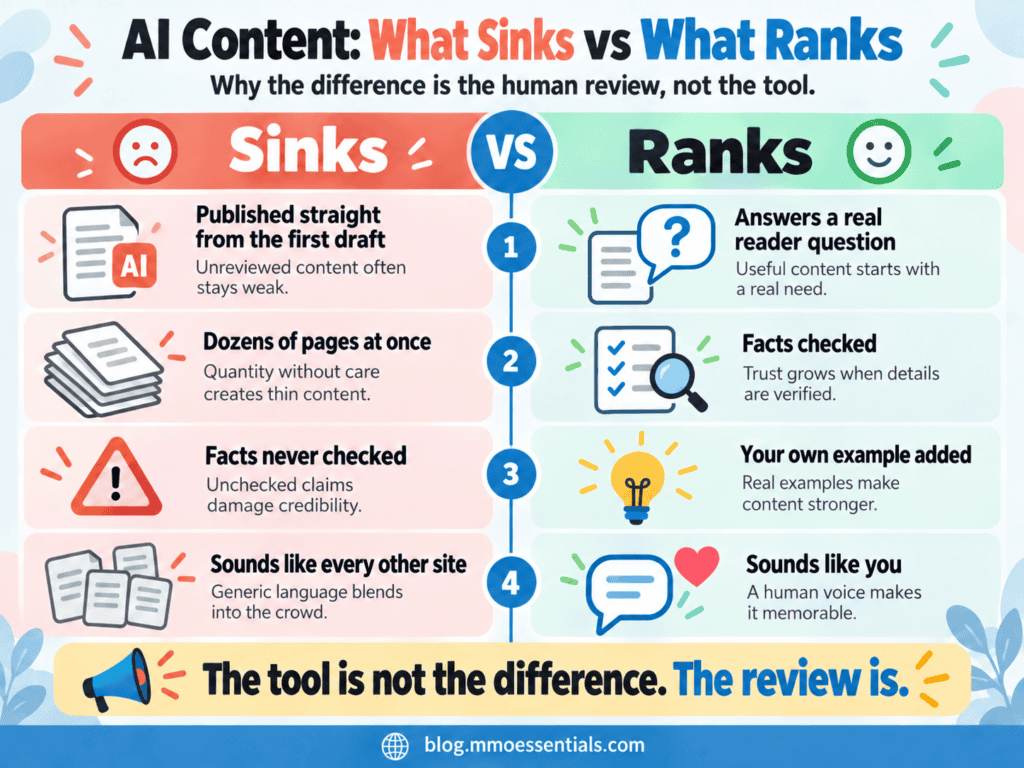
What the tool cannot add, and you can:
A real reason for the post. A question your reader is actually asking, not a topic the tool suggested because it sounded popular.
Facts you have checked. AI can be confidently wrong, which I went into in the post on why AI makes things up. One wrong claim costs you more trust than a slow week of publishing.
Your own example or opinion. This is the part Google’s guidance keeps coming back to with the word experience. A tool has none. You do.
Language you would actually say. If a sentence sounds like a brochure, rewrite it until it sounds like you.
Do those four things and what you publish is simply your post, written faster. That is a long way from the “AI content” people are worried about.
🚫 Publishing the first draft. Fix: treat it as a starting point. Read it as if a stranger wrote it. Fix anything wrong, then rewrite whatever does not sound like you.
🚫 Posting ten a day because you can. Fix: volume without review is the exact pattern Google’s spam policy names. Publish only what you have read.
🚫 Running every post through an AI detector and panicking. Fix: Google’s guidance is about helpfulness, not detector scores. Write for the reader and the detector stops mattering.
🚫 Avoiding AI completely out of fear. Fix: that costs you the drafting help and protects you from nothing. The risk was never the tool.
🚫 Letting AI choose the topic. Fix: the question comes from your reader and your keyword research. The tool helps you answer it.

At MMO Essentials, my method is:
SMS: Start It → Master It → Scale It
Start It by using AI for one part of one post, like the outline, and writing the rest yourself.
Master It by running every AI draft through the same check before it goes live: is it correct, is it useful, does it sound like you.
Scale It by publishing more only once your review habit keeps up. Never faster than you can read what you publish.
You do not need to automate everything at once. Start with the part that helps your reader most. Then build from there.
If you are new to MMO Essentials, you can read more about the beginner-friendly approach on my About page. You can also explore the full MMO Essentials Foundations Library if you want to choose your first free workbook.
No. Lazy content is bad for SEO. AI just makes lazy content faster to produce.
Use the tool for the blank page but always fact check, review and add your own examples, because that is the part Google is looking for, and it happens to be the part your reader is looking for too.
The tool writes quickly. You make it worth reading.
Start with the full guide: AI Limitations: Where the Tool Stops and You Start
Related reading:
👉 AI Hallucination: Why AI Makes Things Up and How to Spot It
👉 AI Email Writing: How to Sound Like You, Not Everyone Else
👉 What Is Prompt Engineering? The Honest, Simple Answer
🎁 This post explains why the human part matters. The free AI Tools Foundations workbook gives you the pages to actually do it.
Part 3: Review Before You Use has the AI Output Check, the short list of questions to run on any draft before it goes near your blog. Part 4: Add Your Human Touch shows a real before-and-after of generic AI wording turned into something a person would say. And Day 5 of the 7-Day Starter Plan is the day you add your own examples and opinion, which is exactly the part this post says Google rewards.
The whole workbook is free. You get a short preview on the page, then you add your email to carry on reading it. You can download the PDF as well if you would rather work through it offline.
Get the free AI Tools Foundations workbook →
No hype, no pressure, just the honest starting point most guides skip.
Not for being AI. Google’s own guidance says appropriate use of AI is not against its guidelines. What its spam policy targets is using AI to churn out lots of pages that add nothing for the reader. The problem is the pattern, not the tool.
Google has not said it ranks pages by whether a tool wrote them. Its published guidance is about whether content is helpful and accurate. So “will Google spot the AI” is the wrong worry. “Is this page actually useful” is the right one.
It can, when a person has checked it and added something real. A reviewed post with your own examples is a normal post. Hundreds of unreviewed pages published in bulk is what the spam policy describes.
It is neutral. AI gets you to a first draft faster. That only helps your SEO if you spend the saved time on the parts that make a page worth ranking, like checking the facts and adding your own examples.





[…] 👉 Is ChatGPT Safe? What You Should Never Put Into an AI Tool👉 What Is Prompt Engineering? The Honest, Simple Answer👉 Is AI Content Bad for SEO? What Google Actually Says […]
[…] 👉 What Is Prompt Engineering? The Honest, Simple Answer👉 Is ChatGPT Safe? What You Should Never Put Into an AI Tool👉 Is AI Content Bad for SEO? What Google Actually Says […]