Physical Address
124 City Road, London EC1V 2NX
Physical Address
124 City Road, London EC1V 2NX

One person says AI will write your whole business for you while you sleep. Another says never touch it or Google will bury you. Someone else says the real answer is a folder of two hundred prompts, and they happen to sell it. Before long, working out how to use AI feels like a second job you did not apply for.
That is not what we are doing here.
The useful conversation is not whether AI is good or bad. It is a much more boring question:
What can this thing actually do, and what does it quietly hand back to you?
Because the AI limitations that matter are not the dramatic ones. Nobody building an online business is worried about robots. They are worried about publishing something wrong, sounding like everyone else, or spending six months producing content that nobody reads.
Those three worries are all downstream of the same thing. AI has a clear edge, and most people have never been told where it is.
✅ Quick Answer: AI can produce a first version of almost anything. It cannot tell you whether that version is correct, whether it suits your reader, or whether it was worth making. Those three checks stay with you, and they are where the actual work lives.
When people write about the limits of AI, they usually mean something philosophical. Consciousness. Reasoning. Whether it truly understands.
None of that matters on a Tuesday evening when you have one hour and a blog post to finish.
The practical version is much simpler. A limitation is any point in your work where the tool stops being able to help and hands the job back to you. If you know where those points are, AI is genuinely useful and you move faster. If you do not, you get a polished draft, you assume it is finished because it looks finished, and you find out it was not somewhere much more expensive.
That is the whole idea. Not “AI is unreliable.” Not “AI is amazing.” Just: here is the line, and here is what sits on your side of it.
These are not theoretical. Each one shows up in ordinary work, usually within the first week of using AI for anything real.
1. It cannot check whether it is right.
This is the big one, and it is not a bug you can prompt your way out of. AI generates text that fits the pattern of a correct answer. Sometimes the correct answer is what fits. Sometimes it is not, and the output reads exactly the same either way.
There is no hesitation in the writing when it is guessing. No “I think” or “you may want to double check this.” Confidence is not evidence, and a clean paragraph is not a checked one.
2. It does not know your reader unless you tell it.
Ask for a blog post about email marketing and you will get a blog post about email marketing. Written for nobody in particular, which means written for everybody, which means written for no one at all.
The tool has no idea whether your reader has an email list already, whether they know what a tag is, whether they have been burned by three courses, or whether they have an hour a week or twenty. All of that has to come from you, in the request, every time.
3. It cannot create experience it does not have.
This is the limit that separates content people finish reading from content they close. AI can tell you that a lead magnet should be specific. It cannot tell you about the one you spent a weekend on that nobody downloaded, or what you noticed when you finally worked out why.
Your actual experience is the one input no tool can generate and no competitor can copy.
4. It has no opinion until you hand it one.
Ask AI whether something is a good idea and it will give you a balanced overview. Pros, cons, it depends. That is not a failure of the tool. It is exactly what it is built to do.
But an overview is not a position, and content without a position is forgettable. What you think, and why you disagree with the common advice, has to be added by you.
5. It cannot decide what your business stands for.
What you will and will not recommend. Whether you promote something you have not used. What you say when the honest answer costs you a sale. These are not writing decisions and no tool can make them.
Hand these over and you do not get a shortcut. You get a business that sounds like everyone else because it was assembled from everyone else.
6. It cannot tell you whether the finished thing is useful.
A forty page draft is not more valuable than a two page one because it is longer. AI has no way of knowing whether what it just produced has a job to do in your business, or whether it is simply more words.
Only you know whether the thing in front of you moves someone one step further along.
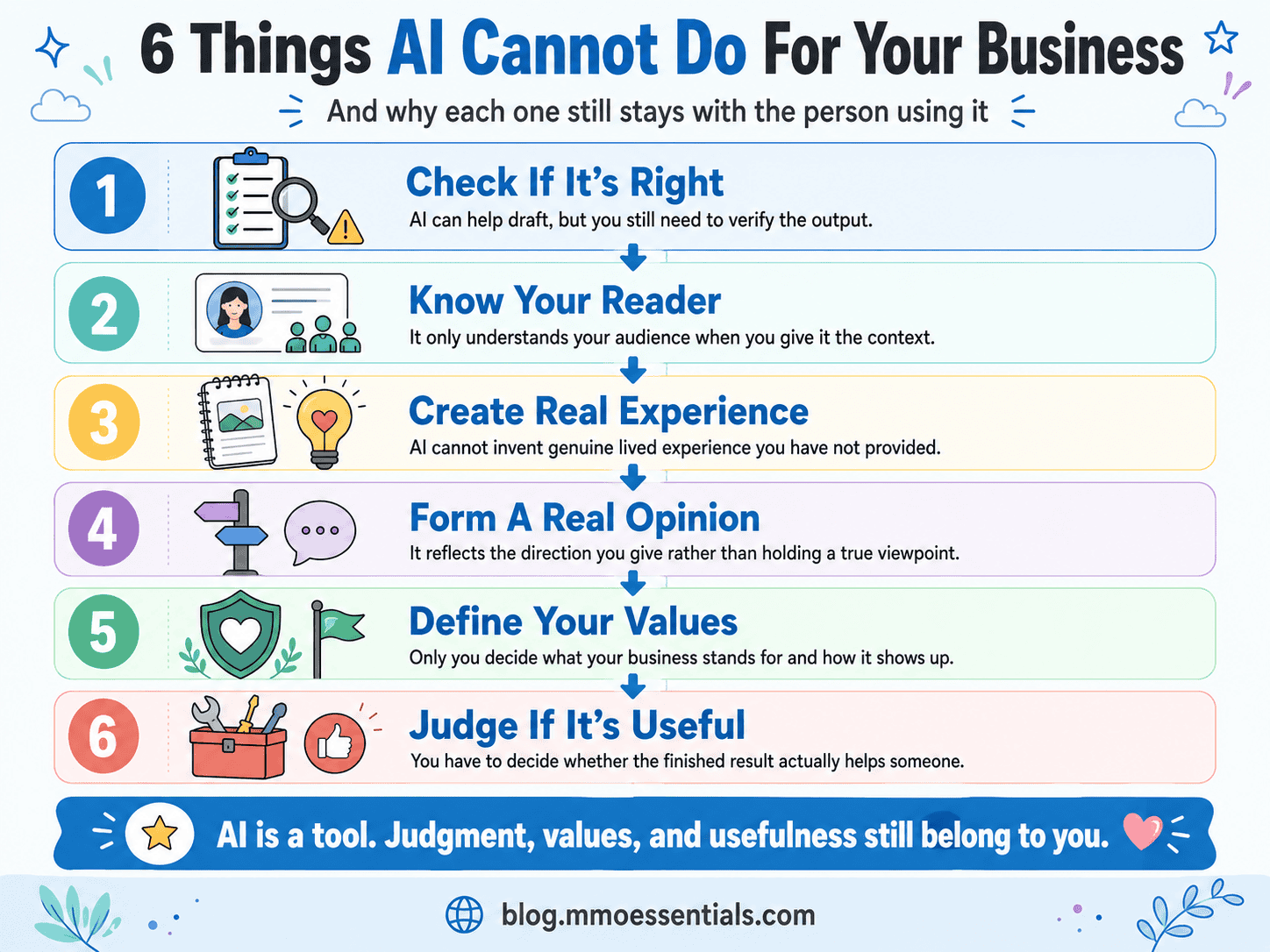
Read that list again and something becomes obvious. Every single limit is a judgement call. AI is genuinely good at production and genuinely unable to do judgement, and almost every problem people have with it comes from asking it to do the second thing.
There is one limitation that stopped being theoretical this year.
Google’s March 2026 core update named scaled content abuse as its main enforcement target. Sites that had published hundreds of AI pages without real editorial work behind them saw traffic drops of fifty to eighty percent. According to one analysis of the fallout, affiliate sites were the hardest hit category overall, with seventy one percent registering a negative impact.
Read that carefully, because it is easy to take the wrong lesson from it.
Google did not penalise AI writing. AI-assisted content now makes up roughly a fifth of top search results, and plenty of it ranks perfectly well. What got hit was volume without judgement. Pages produced at a rate no human could have reviewed, on topics nobody had a reason to cover, published because publishing was cheap.
Which is limit number six arriving with a bill attached. The tool could produce five hundred pages. It could not tell anyone whether those five hundred pages were worth reading, and it turns out that was the only question that mattered.
Readers noticed before the algorithm did, incidentally. Search complaints about “AI slop” are now completely ordinary, from people who have no interest in SEO and simply want a page that answers their question.
Knowing the six limits is one thing. Knowing where they land while you are working is more useful.
A real AI-assisted task has a shape to it, and it is worth seeing the whole shape before you start using it, because most of the frustration people have comes from skipping straight to the middle.
You choose the task. Not the tool. One job that already needs doing, small enough to review properly. Open an AI tool with nothing specific in mind and you will finish with more ideas, more browser tabs, and nothing completed.
You supply the context. Who it is for, what it should achieve, what tone, what to leave out. Limit two lives here. Skip this and you have chosen to receive a generic answer.
You write a clear request. Not a clever one. Clear instructions beat complicated wording, which is why the enormous prompt libraries people collect tend to sit unused.
AI produces a first version. This is the part it is genuinely good at, and it is worth using properly. Having something on the screen to react to beats staring at an empty one, and that is a real saving.
You review it. Limit one lives here, and it is not optional. Read it as if a stranger wrote it, because one did.
You add what only you have. Your example, your opinion, your way of explaining it, the phrase you would actually say out loud. Limits three, four and five all live in this step, which is why it is the one that decides whether the finished thing sounds like you.
You finish something useful. An asset, not an output. Something that has a job in your business.
You save what worked and improve it next time. A small set of instructions for tasks you genuinely repeat beats a folder of two hundred you never open.
Eight steps, and AI does most of the work in exactly one of them. That is not a criticism of the tool. It is the correct division of labour, and it is why people who understand the limits get more out of AI than people who are still looking for the perfect prompt.
The full walkthrough of that process, with the worksheets that go under each step, is what the free AI Tools Foundations workbook covers. This post is the map. That is the terrain.
Three things, in my experience, and none of them are what people expect.
You stop collecting. Once you accept that judgement cannot be outsourced, a second AI subscription stops looking like progress. This matters more than it sounds: working creators commonly run three to five AI tools at somewhere between $150 and $300 a month, and more than half cancel and restart them as they go. Tool accumulation is expensive and it does not fix a single one of the six limits.
You get faster at the boring part. Outlines, first drafts, rewrites, plain-English explanations of things you half understand. This is where the time actually comes back, and it comes back reliably.
Your content stops sounding like everyone else’s. Not because you have found a better tool, but because you have accepted that the parts that make it yours were always going to be typed by you.
Someone on Reddit ran a faceless AI persona account for six weeks recently to find out whether the view money was real. The thread is worth reading, mostly because the answer is so much less dramatic than either side of the argument suggests. It is the same finding underneath: the tool produced plenty. Producing plenty was not the hard part.
If the pull toward the next tool is the thing you keep losing to, that is a separate problem worth naming, and I wrote about it here: You Don’t Need More Tools to Make Money Online.
🚫 Opening the tool before choosing the task. Fix: decide what needs to exist by the end, then open the tool. One job, small enough to check.
🚫 Treating the first response as the finished version. Fix: read it as if someone else wrote it. Check facts, examples, links, and whether it sounds like you.
🚫 Trusting a claim because the sentence around it was well written. Fix: verify anything you would not want your name attached to, against the original source.
🚫 Asking for too much in one go. Fix: break the job into steps you can actually review. A whole guide in one request produces something nobody will read closely, including you.
🚫 Adding another tool to fix an unclear request. Fix: moving a vague instruction between four platforms produces four vague answers. Clarify the task instead.
🚫 Publishing what you cannot stand behind. Fix: if you would not defend the claim to someone who knows the subject, it does not go out. Generation time is not a reason to keep something.
At MMO Essentials, my method is:
SMS: Start It → Master It → Scale It
Start It with one real task you already needed to finish this week, using one tool.
Master It by running the same task three or four times and improving the request each time, until you know exactly which part still needs you.
Scale It only once you have a process you could explain to someone else, not a folder of prompts you never reopen.
You do not need to automate everything at once. Start with the part that helps your reader most. Then build from there.
If you are new to MMO Essentials, you can read more about the beginner-friendly approach on my About page. You can also explore the full MMO Essentials Foundations Library if you want to choose your first free workbook.
The AI limitations that matter are not exciting. They are six ordinary gaps between what a tool can produce and what a business actually needs, and every one of them is a judgement call that stays on your desk.
That is genuinely good news, even though it does not sound like it. It means the tool is not going to leave you behind, because the tool was never doing the part that makes your work worth reading. It also means the shortcut people keep selling does not exist, which saves you a lot of money finding that out one purchase at a time.
Pick one task this week. Give it proper context. Review what comes back honestly. Add the part only you could have added.
That is the whole method, and it works on the free plan.
Start here if you are choosing where to begin: The MMO Essentials Foundations Library
Related reading:
👉 AI Hallucination: Why AI Makes Things Up and How to Spot It
👉 Is ChatGPT Safe? What You Should Never Put Into an AI Tool
👉 What Is Prompt Engineering? The Honest, Simple Answer
👉 ChatGPT for Beginners: Pick One Task, Not One Tool
🎁 This post shows you where the line is. The free AI Tools Foundations workbook gives you the pages that keep you on the right side of it.
Inside, the AI Output Check turns “is this any good” into six written questions you answer before anything gets published, including the two people skip: does it fit your audience, and does it sound like you. The What AI Can and Cannot Do list is the full version of the six limits above, laid out side by side so you can see at a glance which half of a task is yours. And Day 6 of the 7-Day Build is a single job: verify the facts, test the instructions, check the tone, and confirm the thing you made has one useful purpose.
The whole workbook is free. You get a short preview on the page, then you add your email to carry on reading it. You can download the PDF as well if you would rather work through it offline.
Get the free AI Tools Foundations workbook →
No hype, no pressure, just the honest starting point most guides skip.
Organising ideas, drafting first versions, simplifying explanations, comparing options, repurposing something you have already written, and spotting gaps you should look at again. Notice the shape of that list. Every item is a starting point that you then finish. None of them is a finished thing.
Accurate enough to be useful and inconsistent enough to need checking. The problem is not that it gets things wrong. Everything gets things wrong. The problem is that it is just as fluent when it is wrong as when it is right, so there is no tone of voice to warn you. Check anything you would not want your name attached to.
Trust the structure, check the substance. An outline, a rewrite of your own notes, or a plain-English explanation of a term you already half understand are all low risk. A statistic, a source, a link, a quote, a price, or a claim about how a tool works are all high risk. Verify those against the original before you publish them.
Treat it like posting on a forum rather than typing into a private document. Passwords, customer details, financial information, and confidential documents should not go in. General context about who you help and what you sell is usually fine, but read how the specific tool handles what you type before you assume.
It has already replaced a certain kind of writing, the sort nobody was proud of and nobody wanted to read. What it has not replaced is having something to say. AI cannot give you an opinion, an experience, or a reason for your reader to pick you over the next site. Those are the parts that were always doing the work.
Not to start. Free tiers handle outlines, rewrites, explanations, and first drafts perfectly well, which covers most of what you actually need in the first few months. Pay when you hit a specific limit on a task you genuinely repeat, not because a paid plan feels more serious.




[…] That is the pattern Google goes after. Sites that pump out page after page, nobody reads them first, and none of them tell a reader anything new. The March 2026 core update showed what that looks like when it lands, and I covered the fallout in the main guide on where AI stops and you start. […]