Physical Address
124 City Road, London EC1V 2NX
Physical Address
124 City Road, London EC1V 2NX


There is a version of this topic that comes with a job title, a certification, and a course that costs more than your first month of hosting.
There is another version that fits on a postcard.
The gap between those two is where a lot of time gets lost, so it is worth answering the question plainly: what is prompt engineering, and how much of it do you actually need?
✅ Quick Answer: It is the practice of writing clear instructions for an AI tool. That is genuinely it. At a technical level, it is a real discipline for people building AI systems. At your level, it is the difference between “write me an email” and describing who the email is for, what it needs to do, and what to leave out. You can learn the useful part in one sitting.
A prompt is just what you type. Engineering it means putting enough in there for the tool to stop guessing.

That is not a simplification for the sake of it. It is the whole mechanism. AI does not know who your reader is, what you already published last week, what your offer costs, or which of two possible meanings you had in mind. It fills those gaps with the most average answer available, which is exactly why the output comes back sounding like it belongs to nobody.
Give it the missing information and the output changes. That is the entire skill.
Worth being fair about the other version, though. Prompt engineering as a technical discipline is real. OpenAI publishes a prompt engineering guide for developers, and it is full of JavaScript, API calls, model selection and structured JSON outputs. That is a genuine field, and people are genuinely employed in it.
Notice where it lives, though. It sits in developer documentation, aimed at people wiring AI into software. It is not the thing being sold to someone who wants help writing a blog post, even when it borrows the same name.
Rather than hand you a formula, it is more useful to see what is missing when a response disappoints you. Almost every weak answer traces back to one of six gaps.
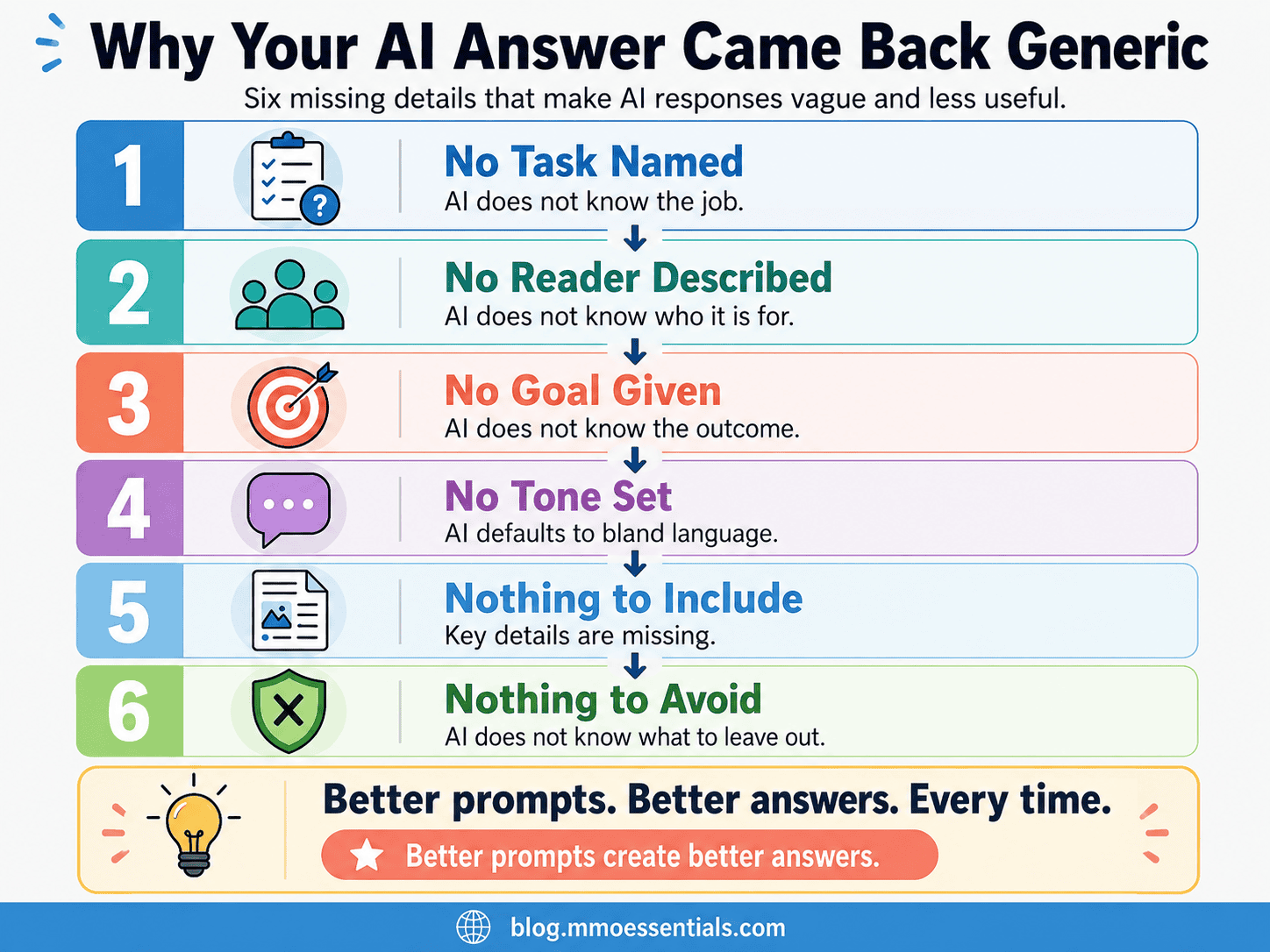
1️⃣ The task is vague. “Help with my newsletter” could mean write it, fix it, shorten it, or come up with the idea. Name the actual job.
2️⃣ The reader is missing. The tool defaults to writing for everyone, and writing for everyone reads like writing for nobody.
3️⃣ The goal is missing. What should the person do or understand afterwards? Without this, you get something that sounds complete but points nowhere.
4️⃣ The tone is unset. Otherwise you get the house style of the internet, which is confident, tidy and slightly pleased with itself.
5️⃣ Nothing was required. If a specific point, example or fact has to appear, say so. It will not guess.
6️⃣ Nothing was ruled out. This is the one people skip, and it does the most work. Ruling things out is how you stop getting the same four clichés every time.
You do not need to remember six things in order. You need to notice which one you skipped when an answer comes back flat, and add it.
Here is the honest reason this feels harder than it is.
“Give clearer instructions” is not something anyone can sell you. “Master prompt engineering before your competitors do” is.
So the idea got dressed up. What is prompt engineering became a subject rather than a habit: it acquired a job title, then certifications, then packs of a thousand prompts, then courses about the packs. Each layer is easier to sell than the last, because each one sounds more like a skill gap and less like something you could work out on a Tuesday afternoon.

The prompt packs are worth a specific mention, because they fail in a way that is easy to miss. A thousand prompts are a thousand instructions written for somebody else’s business. Owning them feels like preparation, and preparation feels like progress, so the folder grows while nothing gets finished. The tools are not the business, and neither is the library of instructions for the tools.
Four or five requests you wrote yourself, for jobs you genuinely repeat, will outperform any pack you can buy. Not because homemade is romantic, but because you know what those jobs need and the pack’s author never did.
🚫 Studying it instead of doing it. Fix: write one real request for one real task today. You will learn more from one poor answer you had to fix than from an afternoon of tutorials.
🚫 Typing three words and blaming the tool. Fix: you would give a colleague more context than that. Give the tool the same.
🚫 Hunting for the magic wording. Fix: there isn’t one. Clear beats clever, and no arrangement of words will get you a better model than the one you are already on.
🚫 Starting a new chat when the answer is wrong. Fix: say what was wrong with it. “Too long, too formal, and it skipped the part about pricing” gets you a better second version than starting over ever will.
🚫 Collecting prompts instead of building assets. Fix: keep only the requests that helped you finish something real. If you cannot name what a saved prompt produced, it is not earning its place.
At MMO Essentials, my method is:
SMS: Start It → Master It → Scale It
Start It with one task you already needed to do, written out as if you were briefing a person rather than a search box.
Master It by running that same request four or five times, adding whichever of the six things you left out, until the first answer is usually good enough.
Scale It by keeping that one request somewhere you can find it, and only then writing a second one.
You do not need to automate everything at once. Start with the part that helps your reader most. Then build from there.
If you are new to MMO Essentials, you can read more about the beginner-friendly approach on my About page. You can also explore the full MMO Essentials Foundations Library if you want to choose your first free workbook.
It is describing a job properly to something that cannot read your mind.
The technical discipline is real and it belongs to people building AI into software. The version being sold to you is mostly that same idea with a price attached.
You are not behind. You have not missed a course. You just need to say more than you have been saying, and notice which piece you left out when the answer comes back sounding like everyone else’s.
Start with the full guide: AI Limitations: Where the Tool Stops and You Start
Related reading:
👉 AI Email Writing: How to Sound Like You, Not Everyone Else
👉 Is ChatGPT Safe? What You Should Never Put Into an AI Tool
👉 AI Hallucination: Why AI Makes Things Up and How to Spot It
🎁 This post explains the idea. The free AI Tools Foundations workbook turns it into something you fill in.
Inside, Part 2: Give Clear Instructions holds the Simple Prompt Builder, which is the six gaps above as a fill-in-the-blank request you can copy and adapt, so you stop rebuilding it from memory every time. Part 6: Save What Works is the page that stops the prompt-hoarding habit, with a four-column system for keeping only the requests that actually produced something. And Part 7: Improve Through Real Use covers the one-change-at-a-time habit that turns a mediocre request into a reliable one.
The whole workbook is free. You get a short preview on the page, then you add your email to carry on reading it. You can download the PDF as well if you would rather work through it offline.
Get the free AI Tools Foundations workbook →
No hype, no pressure, just the honest starting point most guides skip.
Not as a subject, no. You need to be able to describe a task clearly, which most people can already do when talking to another person. The gap is not knowledge; it is that people type three words to a tool where they would have given a colleague three sentences.
It started as a real job at companies building and testing AI systems, where people design and evaluate instructions at scale. That is a genuine technical role. It is not what you are doing when you ask a chatbot to draft an email, and the two got blurred together by people selling courses.
Rarely. A pack of a thousand prompts is a thousand instructions for tasks that are not yours, and having them tends to replace doing the work rather than support it. Four or five requests you wrote yourself, for jobs you actually repeat, will beat any pack you can buy.
Add the things you left out. Who it is for, what it needs to achieve, how it should sound, what to include, what to leave out, and what shape you want it in. Then improve the request each time you use it rather than hunting for a better one.





[…] 👉 AI Hallucination: Why AI Makes Things Up and How to Spot It👉 AI Email Writing: How to Sound Like You, Not Everyone Else👉 What Is Prompt Engineering? The Honest, Simple Answer […]
[…] The second one tells it who the reader is and what shape the answer should take. The answer will be far closer to what you need, and you didn’t need any special tricks to get there. If you want to know why, I explain it properly in the post on what prompt engineering really is. […]