Physical Address
124 City Road, London EC1V 2NX
Physical Address
124 City Road, London EC1V 2NX

You have probably started before.
Maybe you bought the course. Maybe you picked the platform, watched the tutorials, and built something you never finished. Then a few months passed and you started again from a slightly different place.
That is not a discipline problem. It is an order problem.
Most lists of steps to start an online business are not wrong. They are just shuffled. They put the tool at step one and the person you are helping at step nine, which is exactly backwards.
Here is the order that holds up, and the reason each step sits where it does.
✅ Quick Answer: the steps to start an online business
Decide who you help and what problem you solve. Build one small useful thing that solves it. Put a simple sign-up path around it so people can get it. Then publish helpful content that points at that path. Tools come last, after you know what you are building.
Every step you take out of order has to be redone later.
Pick your email platform before you know who you are helping, and you will rebuild the sign-up page once you find out. Write the lead magnet before you know the problem, and you will rewrite it. Buy the domain before you know the topic, and you own a name that no longer fits.
None of that is wasted because you were lazy. It is wasted because the decisions were made in the wrong sequence.
There is one rule underneath all of this: every decision should be made using information you already have. If a step needs an answer you have not worked out yet, it is too early.
That single rule sorts most of it for you.
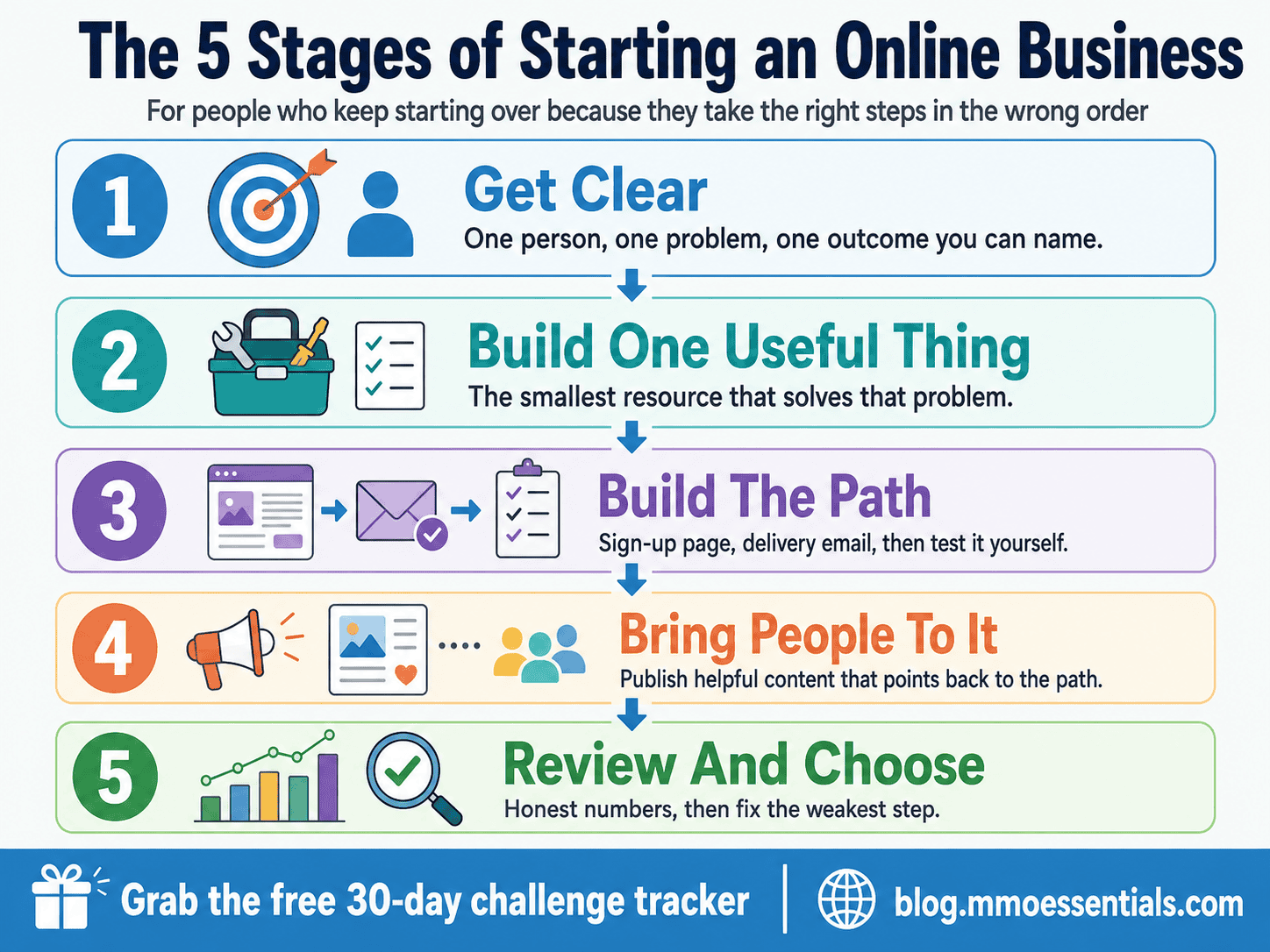
Here is the whole thing, broken into stages. Each stage answers a question the next stage depends on.
You are answering one question here. Who is this for, and what problem am I solving?
Nothing gets built this week. That feels slow, and it saves you the most time of any stage on the list.
Now you make the thing that solves the problem from step 3.
This is your lead magnet. It does not need to be long. It needs to finish something for the reader.

The asset exists. Now people need a way to get it.
Step 20 is the one people skip, and it is the one that catches the broken link, the email that never arrives, and the button that goes nowhere.
A path nobody walks down is not a business yet.
Notice that you are giving the answer away, not teasing it. That is what earns the sign-up.
Small numbers at this stage are normal. They are also the only numbers that tell you anything true.
It is rarely the building. It is stage 1.
Choosing one person feels like turning down everybody else, so it gets skipped or half-done. Then every later step gets harder, because you are writing for a blur instead of a person.
If you cannot finish the sentence “this helps [person] who is stuck on [problem],” go back. Everything downstream depends on it.
🚫 Picking the tools first. The platform cannot tell you who you help. Choose the person, then pick tools that fit.
🚫 Building something big. A 40-page guide takes two months and teaches you nothing you could not learn from a two-page one.
🚫 Skipping the test. Sign up to your own path before anyone else does. There is always one broken step.
🚫 Starting over after a quiet week. Quiet weeks are data, not verdicts. Fix one step and keep the rest.
🚫 Waiting until it is polished. Published and imperfect beats finished and hidden, every time.
Less than most people expect at the beginning, because the first half of the work is thinking and writing rather than buying. Steps 1 to 14 on this list cost nothing at all. You only need tools once you build the sign-up path, and most email and page platforms have a free plan that covers you until people are genuinely joining. Add paid tools when something is working, not before.
You can build one for free. A free email platform, a free page builder and your own writing will get you a working sign-up path from start to finish. What you cannot get for free is the time, and that is the real cost. Paid tools make sense later, once the thing is running.
You can have a working system in about 30 days doing one small step a day. That is a system, not an income. How long it takes to earn anything depends on your topic, your audience and how consistently you publish, and anyone who gives you a specific figure is guessing.
Choosing one person to help, and one problem of theirs you can solve. Not the platform, not the domain, not the logo. Every later decision gets easier once you can finish this sentence: “This helps [person] who is stuck on [problem].”
Yes, and the constraint quietly helps. Fifteen or twenty minutes on one specific task survives a busy week, where waiting for a free Saturday usually does not. The 30 steps here are sized for exactly that.
No, although it is too late to succeed by copying what worked five years ago. What still works is picking one person, solving one real problem properly, and publishing consistently enough to be found. That part has not changed.
You do not need every tool at once.
For MMO Essentials, I use Systeme.io for email campaigns, tags, workflows, and follow-up. I also use LeadCreator for workbook-style lead magnets that connect nicely with my blog content, and PostSyncer to help schedule social media posts as I start repurposing content across platforms.
Some tool links I share may be affiliate links, which means I may earn a commission if you choose to use them, at no extra cost to you. I only mention tools when they fit the beginner-friendly system I am explaining. You can read more about how disclosure like this works in the FTC’s endorsement guidance.
At MMO Essentials, my method is:
SMS: Start It → Master It → Scale It
Start It with one person and one problem, written down where you can see it.
Master It by taking all 30 steps once, start to finish, even if the result is small.
Scale It only after the path works and someone who is not you has been through it.
You do not need to automate everything at once. Start with the part that helps your reader most. Then build from there.
If you are new to MMO Essentials, you can read more about the approach on my About page.
You can also explore the full MMO Essentials Foundations Library if you want to choose your first free workbook.
The steps to start an online business are not a secret. You have probably read a version of them before.
What changes the result is doing them in an order where each one has the information it needs, and doing one a day instead of all of them on a Sunday afternoon that never comes.
Thirty small steps. One at a time. That is genuinely the whole method.
👉 New to all of this? Start with how to make money online from home for the wider picture.
👉 Working out what your useful thing should be? Read what is a lead magnet.
👉 Ready for the sign-up side? Read how to build an email list.
👉 Wondering what to send once people join? Read what is an email sequence.
🎁 Want the 30 steps as something you can tick off?
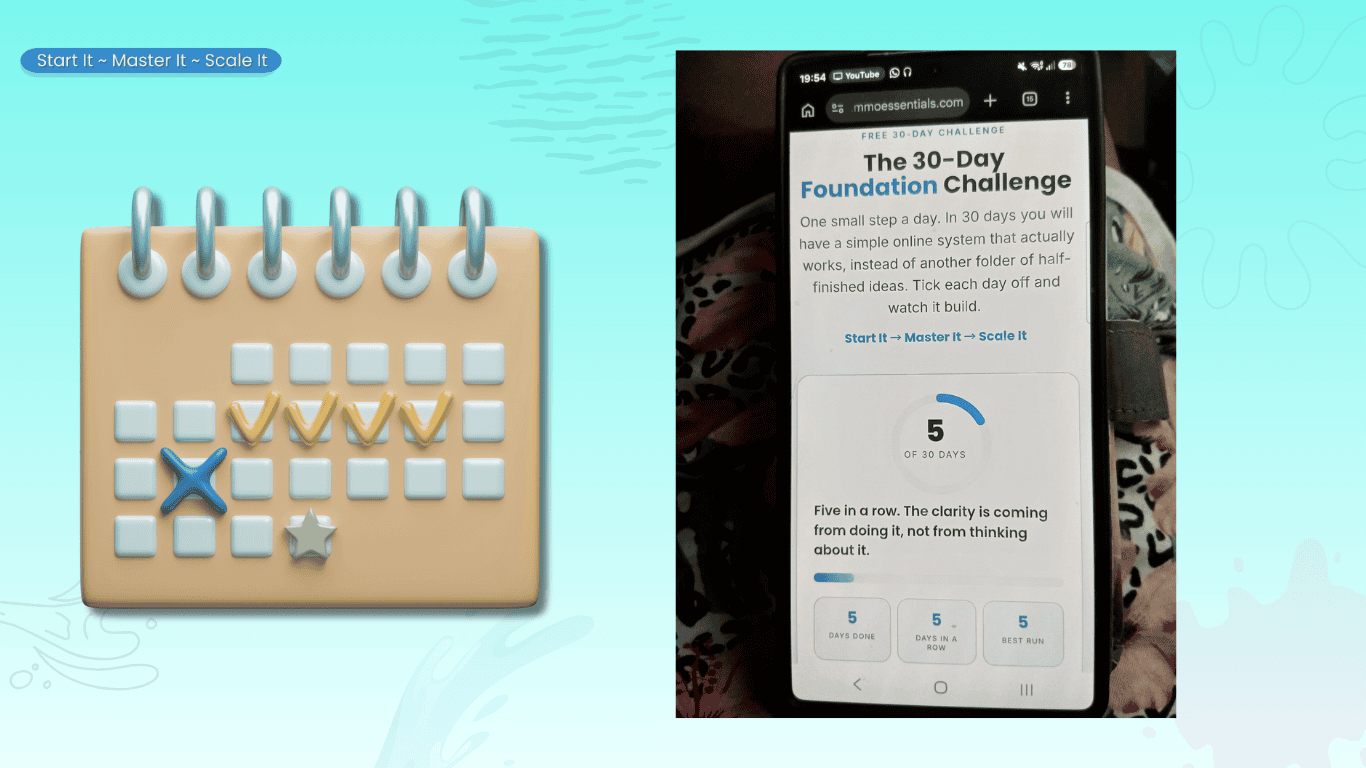
I built a free 30-Day Foundation Challenge tracker. Every step above is in there as its own day, with tick boxes, a progress bar, and a streak counter that saves in your browser. No app, no login.
👉 Get the free 30-Day Foundation Challenge tracker
Start It → Master It → Scale It