Physical Address
124 City Road, London EC1V 2NX
Physical Address
124 City Road, London EC1V 2NX
You’ve probably seen the word “affiliate” a hundred times before you ever understood what it meant. It shows up in disclaimers under YouTube videos, in tiny text at the bottom of blog posts, in the phrase “affiliate link” that everyone uses but nobody quite explains.
So let’s actually answer it. What is affiliate marketing, and why does everyone talk about it like it’s either the easiest way to make money online or a total scam?
Neither one is true. Affiliate marketing is a real, ordinary way to earn a commission by recommending something that genuinely helps someone. That’s the whole mechanism. Everything else people tell you about it, the shortcuts, the secrets, the guaranteed income, is noise sitting on top of something actually quite simple.
Part of the confusion isn’t really about affiliate marketing itself. It’s about all the terminology that gets thrown around alongside it: funnel, landing page, opt-in, tag, tracking link, cookie duration. None of these words are complicated once someone explains them plainly, but hearing them all at once, with no order and no context, is exactly what makes affiliate marketing feel harder than it actually is. This guide sticks to plain language on purpose, and explains a term the first time it shows up rather than assuming you already know it.
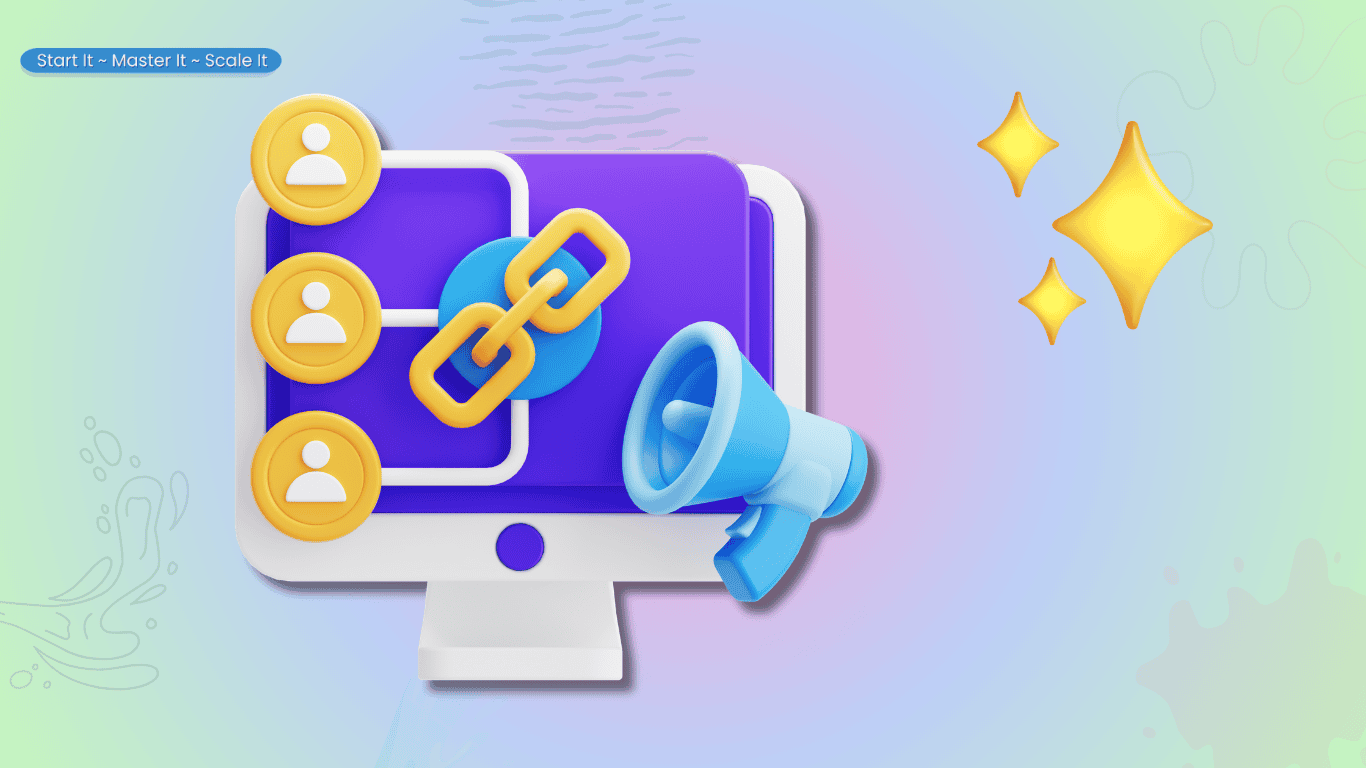
At its core, it’s simple: you point someone toward something that genuinely helps them, and if they buy it through your link, the company pays you a small commission. You don’t own the product, and you’re not the one handling payment or shipping. Your part is smaller and more specific than people assume: you help someone find the right thing, and the company pays you for that help.
That’s it. There’s no hidden trick underneath it. The part that trips people up isn’t the mechanism, it’s what they think comes before it.
Here’s a belief worth challenging directly: affiliate marketing is not a business on its own. It’s one piece of a business that’s actually built on something else.
Think about what has to exist before a single commission can happen. Someone has to find your content, then trust what you’re telling them enough to click, then believe the recommendation is honest rather than just profitable for you. None of that comes from the affiliate link itself. It comes from the helpful content, the real understanding of one audience’s problem, and the trust you’ve built before you ever mentioned a product.
Skip straight to the link, and you’re asking a stranger to trust you before you’ve given them any reason to. That’s a much harder sell than it needs to be, and it’s a big part of why so many beginners try affiliate marketing for a few weeks, hear nothing but silence, and quietly give up.
Strip away the hype and the process is genuinely simple. Here’s the real shape of it, beginning to end:
You choose one audience and one problem. Not everyone. Not every problem. One specific group of people with one specific thing they’re trying to solve.
You create something helpful. A blog post, a short video, a simple explanation, anything that actually answers a real question that audience has. This step matters more than any other on this list, and it’s the one most beginners skip.
You build trust before you recommend anything. People rarely search for affiliate links. They search for answers. If you become the person who explains the answer clearly, the recommendation starts to feel like advice from someone who gets it, not an ad.
You recommend a product because it fits, not because it pays well. The honest test here is simple: would you still recommend it if there were no commission attached? If the answer is no, that’s worth paying attention to.
You place the affiliate link. This is the smallest step in the whole process, even though it’s the one everyone focuses on first.
You keep the relationship going. Someone who trusted one recommendation is far more likely to trust the next one, especially if you’re still around, still helpful, still honest. This is usually where an email list comes in.
You track what’s working and improve. Not obsessively. Just paying attention to what your audience actually responds to, and adjusting from there.
None of these steps require you to be an expert, have a big following, or already understand every affiliate program on the market. They just need to happen in the right order.
Here’s what actually happens behind the scenes once someone clicks your link, since this is another spot where jargon gets in the way of a fairly simple idea.
Your affiliate link contains a small tracking code unique to you. When someone clicks it, that code gets stored, usually as something called a cookie, for a set window of time (this is the “cookie duration” you’ll see mentioned in program terms, anywhere from 24 hours to 90 days or longer, depending on the program). If that person buys within that window, the sale gets attributed to you, and you’re paid a commission, either a flat amount or a percentage of the sale.
Some programs pay once per customer. Others, especially subscription-based tools, pay a recurring commission for as long as that customer stays subscribed. That difference matters more than people realize when they’re choosing which programs to focus on, and it’s covered properly in: Beginner Affiliate Programs: How to Choose Your First One.
If there’s one idea worth taking from this entire piece, it’s this: trust isn’t a nice extra on top of affiliate marketing, it’s the actual foundation the whole thing sits on.
That changes how you should think about almost every decision. It changes which products you choose (ones you’d stand behind even without the commission). It changes what you create first (helpful content, not a list of links). It changes how you talk about a recommendation (honestly, including the limitations, not just the upside).
Here’s a simple test that cuts through most of the second-guessing beginners feel about affiliate marketing: would you still recommend this product if there were no commission attached at all?
If the honest answer is yes, you’re in genuinely good shape, the commission is just a fair reward for help you’d have given anyway. If the honest answer is no, that’s worth sitting with for a moment, because that’s usually the gap between a recommendation that builds trust and one that quietly damages it.
This single question also answers a fear a lot of beginners carry into affiliate marketing without saying out loud: “what if I recommend the wrong thing?” You’re allowed to be wrong about a product occasionally; that happens to everyone. What actually damages trust is recommending something you never believed in to begin with, just because the commission looked good.
How to Start Affiliate Marketing the Right Way: Build Trust Before You Promote goes deeper into exactly what this looks like in practice, what to build first, and how to avoid the most common beginner mistake of trying to earn before you’ve actually helped anyone.
Is affiliate marketing legit, or is it basically a pyramid scheme?
It’s a completely legitimate, widely used marketing model, companies from small software tools to major retailers run affiliate programs. It’s also regulated, not just informally trusted: the FTC requires clear disclosure whenever a link could earn you money, which is exactly why every honest affiliate marketer discloses their links openly instead of hiding them. The confusion usually comes from a different source: some people wrap affiliate marketing in exaggerated income promises and hype, and that hype is what earns the industry a bad reputation, not the underlying model itself. Is Affiliate Marketing Legit? An Honest Answer for Beginners– covers this in full.
How much do affiliate links actually pay?
It depends heavily on the product, the program, and the price point, there’s no single honest answer that applies to everything. How Much Do Affiliate Links Pay? A Beginner’s Guide breaks down real, realistic numbers instead of inflated examples.
Do I need a website or a big following to start?
No. You need somewhere to publish helpful content and a way for people to find it, that could be a blog, a YouTube channel, or a social platform. Followers help, but they’re not the starting requirement people assume they are. What matters more is whether the right small number of people trust what you’re saying.
Which affiliate program should I join first?
Fewer than you think. Joining too many programs at once is one of the most common beginner mistakes, it spreads your attention across products you don’t understand well enough to genuinely recommend. Beginner Affiliate Programs: How to Choose Your First One walks through how to choose one worth starting with.
What’s the difference between high ticket and low ticket affiliate programs?
Mostly the size of the commission and the size of the decision the buyer is making. Higher-priced products usually mean a slower, more considered sale. High Ticket Affiliate Marketing, Without the Hype breaks down what that actually means, and why the more useful comparison is one-off versus recurring.
This is probably the objection that stops more beginners than any other, so it deserves a direct answer instead of a quick line in an FAQ.
You don’t need thousands of followers to start. You need one small group of people who trust what you’re saying, and that group can start at a handful of readers or viewers. A following is a lagging indicator of helpful content done consistently, not a prerequisite for starting it. Plenty of the beginners who eventually build a real audience started by writing or filming for an audience of almost nobody, and kept going anyway because they were solving a real problem for the few people who were there.
The related fear, “I’m not an expert, who am I to recommend anything,” misses something important too. You don’t need to be the world’s leading authority on a product. You need to have genuinely used it, understood who it helps and who it doesn’t, and be willing to say both parts honestly. That’s a much lower bar than “expert,” and it’s one almost anyone willing to do the work can clear.
A few patterns show up over and over in people just starting out with affiliate marketing. None of them are character flaws, they’re just the natural result of jumping to the link before doing the quieter work underneath it.
Trying to earn before learning. Chasing a first commission before understanding how the whole process actually fits together usually means promoting the wrong thing to the wrong audience.
Joining too many affiliate programs at once. Spreading your attention across five or six programs means you understand none of them well enough to recommend any of them convincingly.
Creating content without a clear audience. Content aimed at “everyone” tends to land with no one. The more specific the person you’re writing for, the more useful the content actually becomes.
Buying tools instead of building assets. A new piece of software rarely fixes an unclear system. The tools support the foundation, they aren’t the foundation itself.
Waiting for perfect knowledge before publishing anything. Nobody starts with complete understanding. The people who make progress are the ones who publish the useful, honest, slightly-imperfect version and improve it from there.
The fix for all five isn’t complicated, it’s just a different order than most guides teach it: understand the mechanism, choose one audience, create something helpful, build trust, then recommend.
Affiliate marketing works best as one part of a simple system, not the whole system. The tools and the affiliate program itself aren’t the business, they’re just what the actual foundation runs on: a clear audience, helpful content, real trust, and a way to keep in touch with people once they’ve found you (usually an email list).
If you’re only thinking about affiliate marketing in isolation, right now is a good moment to zoom out. A working online business is built in a specific order, and affiliate marketing tends to work far better once the pieces underneath it are actually in place.
That’s exactly what the Affiliate Marketing Foundations workbook walks you through. Not theory, a practical map: choosing one audience, creating content that actually helps, building trust before you promote anything, choosing products carefully, and keeping the relationship going afterward. It’s free, it takes about the time of a coffee break to read the core of it, and you can start applying it the same day.
Get the free Affiliate Marketing Foundations workbook →
No hype, no pressure, just the honest starting point most guides skip.